Seed Grant Program
The Department of Surgery's Seed Grant Program supports work that addresses a clear and important gap in knowledge. Proposed studies must offer a unique or previously unpublished contribution to the field and will be assessed based on potential for seed grant to lead to follow on funding.
Eligibility:
• All Department of Surgery faculty are eligible—including affiliated faculty (i.e.,VAMC, etc)—EXCEPT members of the Research Oversight Committee.
• Trainees are NOT eligible
• All types of research are eligible: basic, HSR, clinical trials, technology development, education, global surgery
• Can fund personnel, equipment, reagents, consultants, etc. (justification must be included in proposal)
Funding:
• Total first round funding $250,000, 3-6 proposals selected
• Accepting proposals with budgets ranging from $10,000 - $50,000
• Funding duration: 12 months
Research Seed Grants
Research seed grant proposals include hypothesis-driven projects in the categories of (1) basic and translational science, with potential for future applications to a clinical condition, and (2) health services/outcomes/education research with potential for a future interventional study. At least one research grant will be reserved for a proposal that addresses the topic of racial justice, equity, diversity, and inclusion. All Research Seed Grant proposals should be oriented toward generating pilot data for an external funding proposal. In the case of the racial justice, equity, diversity, and inclusion proposals the planned external funding proposal should seek to advance our knowledge or to develop an intervention to address racial equity and social justice in medicine.
Technology/Innovation Seed Grants
Technology/Innovation projects are focused on the development of technology such as new medical devices, drugs, and apps intended to improve the care of patients.
These projects do not include “hypothesis-driven” research on commercially available technology/devices, such as an early observational study of devices from outside vendors.
These projects should typically involve some form of IP development, and resources should be used to further the development of the technology. Examples include prototyping of medical devices, engaging clinical/regulatory consultants, developing an intellectual property strategy, medicinal chemistry formulation work, and many others.
At the end of the period of funding, it is anticipated that grantees will be able to secure further innovation-focused funding from Stanford-specific programs (Coulter Foundation, Spectrum, SPARK, etc.), federal sources (SBIR/STTR grants, FDA grants), or private investors (VCs, Angel investors, strategics). The ultimate goal of this program is to enable the translation of Stanford Surgery ideas into “first-in-man” or “proof of concept” clinical trials at Stanford. These proposals will be reviewed and graded by the Innovation Council (IC).
Apply
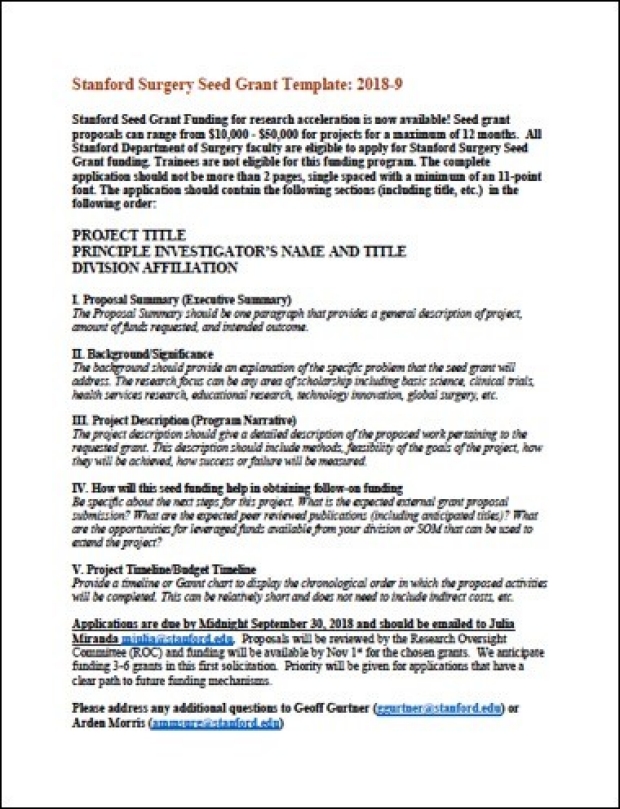
All seed grant applications (both research and technology development) are due November 15 at 11:59pm. The complete application should be no more than 2 pages including figures, single-spaced with a minimum of 11-point font. Applications are limited to one per faculty member. Priority will be given for applications that have a clear path to future funding mechanisms. Applications should be submitted via this google form. Please note that you will be asked to log in to your Stanford Google account. Instructions on how to do so here.
Feel free to direct questions regarding research proposals to Olivia Martinez (omm@stanford.edu) or Arden Morris (ammsurg@stanford.edu) and innovation proposals to Carla Pugh (cpugh@stanford.edu)
Awardees
HSR-Clinical Category
*Evaluating post-discharge financial outcomes among acute care surgery patients. -Lisa Knowlton, MD, MPH General Surgery
Pressurized intraperitoneal aerosolized chemotherapy (PIPAC) in advanced unresectable gastrointestinal malignancy. -Byrne Lee, MD, General Surgery
Basic-Translational Category
*Deciphering the racial disparity in chemotherapy-induced vascular toxicity using iPSCs. -Nazish Sayed, MD, PhD, Vascular Surgery
Automated quantification of liver fibrosis at diagnosis of biliary atresia using a collagen matrix ultrastructure analysis. -Jeong Hyun, MD Pediatric Surgery
Innovation Seed Grants
“Augmented Reality-Assisted, Scout-Localized, Breast Lumpectomy Pilot Demonstration Project” -Jacqueline Tsai, MD General Surgery
“Reconditioning of aged livers via a normothermic perfusion device and a stem cell-activating biologic” -Varvara A. Kirchner, MD Abdominal Transplantation
*denotes a proposal that addresses the topic of racial justice, equity, diversity, and inclusion