Research
G Protein Coupled Receptors
G Protein Coupled Receptors
G-protein-coupled receptors, or GPCRs, are a family of approximately 800 membrane proteins in the human genome. They mediate the majority of cellular responses to hormones and neurotransmitters, and are therefore essential for communication between cells located in different parts of the body. GPCRs also mediate the senses of sight, smell and some tastes. Given their role in the regulation of all aspects of human physiology, GPCRs are the targets of nearly half of today's pharmaceuticals.
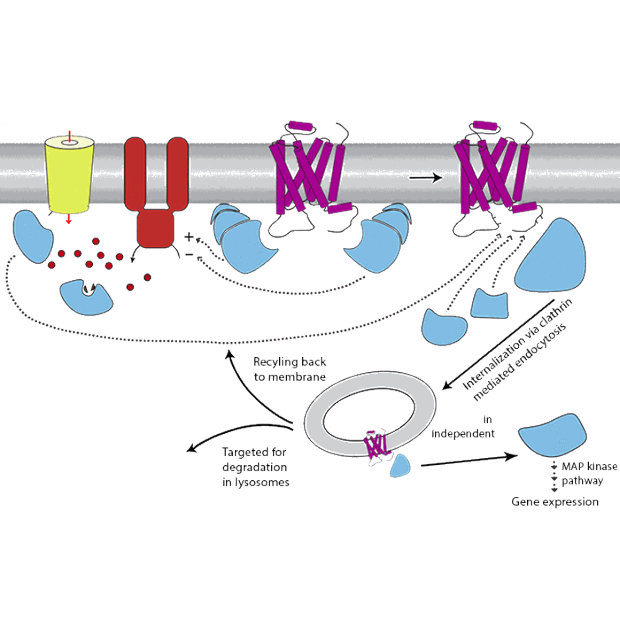
GPCRs are located on the plasma membrane of cells and share a common seven transmembrane topology. These highly versatile receptors can respond to a broad range of ligands ranging from ions, to small organic molecules, to peptides and large protein hormones. GPCRs also interact with a number of signaling and regulatory proteins within the cell including G proteins, kinases and arrestins.
The goal of research in my lab is to characterize the structure and mechanism of activation of G protein coupled receptors (GPCRs). My lab has employed a variety of approaches including cell biology, gene disruption in mice, and in vivophysiology to determine the role of specific adrenergic receptor subtypes in normal physiology. During the past 20 years we have applied a spectrum of biochemical and biophysical tools to study different aspects of GPCR structure and activation.
G-protein-coupled receptors, or GPCRs, are a family of approximately 800 membrane proteins in the human genome. They mediate the majority of cellular responses to hormones and neurotransmitters, and are therefore essential for communication between cells located in different parts of the body. GPCRs also mediate the senses of sight, smell and some tastes. Given their role in the regulation of all aspects of human physiology, GPCRs are the targets of nearly half of today’s pharmaceuticals.
GPCRs are located on the plasma membrane of cells and share a common seven transmembrane topology. These highly versatile receptors can respond to a broad range of ligands ranging from ions, to small organic molecules, to peptides and large protein hormones. GPCRs also interact with a number of signaling and regulatory proteins within the cell including G proteins, kinases and arrestins.
The goal of research in my lab is to characterize the structure and mechanism of activation of G protein coupled receptors (GPCRs). My lab has employed a variety of approaches including cell biology, gene disruption in mice, and in vivophysiology to determine the role of specific adrenergic receptor subtypes in normal physiology. During the past 20 years we have applied a spectrum of biochemical and biophysical tools to study different aspects of GPCR structure and activation.
GPCR Structure
Inactive State GPCRs
In 2007 we obtained two crystal structures of the β2 adrenergic receptor (β2AR): as a β2AR-Fab complex and as a β2AR-T4L fusion protein. These were the first structures of a hormone/neurotransmitter activated GPCR. The method that we developed to obtain crystals of the β2AR (generating fusion proteins with T4 Lysozyme or other highly stable soluble proteins) has subsequently been used to crystallize many other GPCRs including the following structures from our lab: the M2 and M3 muscarinic receptors, the mu- and delta-opioid receptors, and the protease activated receptor (PAR1). These structures all represent inactive states of these GPCRs.
Active-State GPCRs
We have also been able to obtain several active-state GPCR structures using camelid antibody fragments (nanobodies) to stabilize the active conformation. These include the β2AR, the M2 muscarinic receptor and the mu-opioid receptor. These crystallography studies provide high-resolution snapshots of transmembrane signaling by G protein coupled receptors, as well as insights into the structural basis for ligand binding specificity.
GPCR-G Protein Complex
In 2011, we succeeded in obtaining the structure of the β2AR-Gs complex as part of an extensive collaboration involving the laboratories of Roger Sunahara, Georgios Skiniotis, Bill Weis, Jan Steyaert and Martin Caffrey. This structure caught the β2AR in the act of activating the G protein Gs and revealed unexpected structural changes in the Gs alpha subunit.
Protein Dynamics
My lab also has a great interest in the contribution of protein dynamics to the functional versatility of GPCRs. Our approaches to obtain GPCR crystal structures have been guided by insights from biochemical and biophysical studies aimed at characterizing their dynamic behavior. We are currently using fluorescence, NMR and EPR spectroscopy, as well as single molecule fluorescence spectroscopy to provide additional insights into the dynamic properties of GPCRs.