
Enriching the Learning Community
The Stanford Immunology program recognizes that the Supreme Court issued a ruling in June 2023 about the consideration of certain types of demographic information as part of an admission review. All applications submitted during upcoming application cycles will be reviewed in conformance with that decision.
The Stanford Immunology program welcomes graduate applications from individuals with a broad range of life experiences, perspectives, and backgrounds who would contribute to our community of scholars. The review process is holistic and individualized, considering each applicant’s academic record and accomplishments, letters of recommendation, prior research experience, and admissions essays to understand how an applicant’s life experiences have shaped their past and potential contributions to their field and how they might enrich the learning community at Stanford.
The Immunology Home Program is one of fourteen Biosciences PhD programs at the School of Medicine. We welcome applications from students with a variety of scientific backgrounds and believe that diversity of previous experience enriches our multidisciplinary environment. Learn more about our program here.
The PhD Program in Immunology, founded in 1988, is one of fourteen Stanford Biosciences programs. The goal of the PhD Program in Immunology is to provide outstanding training and education for obtaining the PhD degree in Immunology and to develop young investigators who will carry out innovative research in the field. Our 60+ students benefit greatly from the long tradition of collaboration among the immunology laboratories, with an emphasis on the application of cutting edge approaches to problems in cellular, molecular, computational, and clinical immunology. Immunology faculty members are leaders in their respective areas of research, and often incorporate bench to bedside approaches. Our PhD core coursework requirements plus strong electives in related disciplines provide an integrated curriculum that spans basic and clinical immunology. Students can choose from either the Molecular, Cellular, and Translational Immunology (MCTI) track or the Computational and Systems Immunology (CSI – founded in 2011) track. Graduate students in immunology actively participate in seminars, journal clubs, and the annual Stanford Immunology Scientific Conference at Asilomar. Students have access to state-of-the-art research facilities in the immunology laboratories, located in various departments in the School of Medicine, the Department of Biological Sciences, and the Palo Alto Veteran's Administration Medical Center.
MCTI and CSI tracks
Click on the + icon for descriptions of the MCTI and CSI tracks
Before You Apply
Thank you for your interest in the 14 Stanford Biosciences PhD Programs. The application for Autumn 2024-25 will open on September 15, 2023. The application deadline is Tuesday, December 5, 2023 at 11:59:59 pm (PST).
If selected for further consideration, the Interview Session is from Wednesday, March 6 through Sunday, March 10, 2024 at Stanford University School of Medicine in Palo Alto, CA.
For information about the 14 Biosciences PhD Programs and How to Apply, please visit https://biosciences.stanford.edu/how-to-apply/ and https://biosciences.stanford.edu/how-to-apply/application-faq/. Please be sure to read through both of these pages carefully as a vast majority of the
commonly asked application questions will be answered there.
For information about our admissions process, our faculty, and Stanford University, please visits the following websites:
How to Apply
To apply or for more information on the admissions process and requirements, please visit the Stanford Biosciences "How to Apply" PhD admissions page. Please indicate in your personal statement in your application which Immunology track you wish to pursue, the Molecular, Cellular, and Translational Immunology or Computational and Systems Immunology track.
Applying and Deadline
Thank you for your interest in the 14 Stanford Biosciences PhD Programs. The application for Autumn 2024-25 will open on September 15, 2023. The application deadline is Tuesday, December 5, 2023 at 11:59:59 pm (PST).
If selected for further consideration, the Interview Session is from Wednesday, March 6 through Sunday, March 10, 2024 at Stanford University School of Medicine in Palo Alto, CA.
In addition to the information below, please review the Graduate Admissions website prior to starting your application. When you are ready to apply, please click here to start your online application.
Any questions or concerns about the application process should be addressed to: biosciences@stanford.edu
Letters of Recommendation
At Stanford Immunology, we are keenly interested in what your previous mentors and advisors have to say regarding your application to our PhD program. Furthermore, we acknowledge that not all applicants receive appropriate guidance around requesting strong reference letters from their letter writers. Thus, we recommend applicants go over the following resources to ensure they put forward the best possible application package:
Resources as a letter seeker: Ten simple rules for navigating the reference letter seeking process
Resources as a letter writer: Ten simple rules for writing compelling recommendation letters
Stanford Immunology Review Program for Applicants (SIRPA)
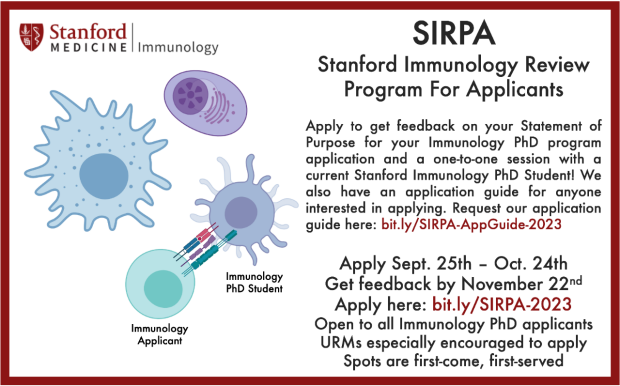
The Stanford Immunology Review Program for Applicants (SIRPA) is a CDIII committee-supported student-organized initiative that strives to assist individuals applying to the Immunology PhD program. Participants will receive one round of feedback on their statements of purpose. Participation in this program does not guarantee admission, and applicants that don’t participate in this program will not be penalized in any way. Participation in this program will be kept confidential from Immunology Faculty and other members of the Immunology PhD Admissions Committee.
Submissions for the Application Guide and SIRPA program have now closed. Please check back in September 2024 for additional information.
Official Transcript Requirement
Graduate Admissions only requires admitted applicants who accept the offer of admission to submit official transcripts that shows their degree conferral. More details on this can be found on the following Graduate Admissions webpage. Please do not send or have sent any official transcripts to our office.
GRE Test Requirements
GRE General Test scores are not considered.
GRE Subject Test scores are not considered.
TOEFL Test Special Accommodations
Please see the Graduate Admissions "Required Exams" web page for information regarding COVID-19 and special TOEFL Test accommodations.
Stanford Biosciences PhD Admissions Contact Information
Website: https://biosciences.stanford.edu/
Email: biosciences@stanford.edu

The Stanford Biosciences Home Programs comprise nine departments and five interdisciplinary programs, which span the School of Medicine and the School of Humanities and Sciences.